2026.04.04 (토) 20:19




 닫기
닫기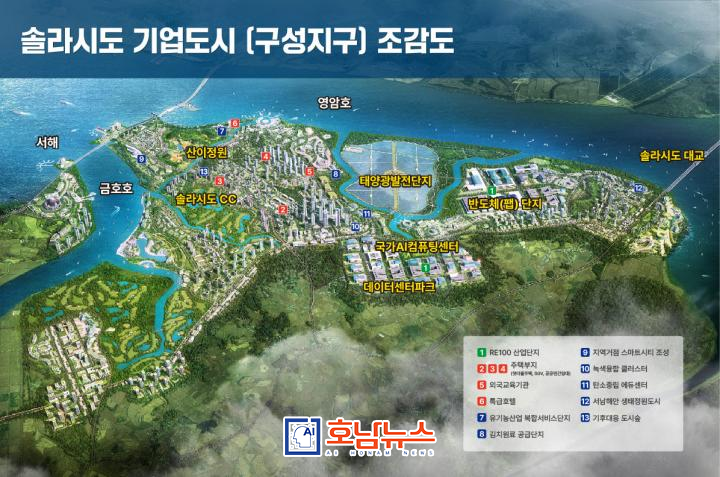 솔라시도 기업도시 조감도 / 사진제공=호남뉴스 |
【전남·광주=AI호남뉴스】 aihnnews@kakao.com
지금 솔라시도는 완전히 다른 시대 위에 서 있다.
과거 J프로젝트가 공간 개발의 논리로 접근했다면, 현재의 솔라시도는 산업 구조 자체를 재편하는 전략적 거점으로 다시 정의되고 있다.
그 중심에는 단 하나의 키워드가 있다.
AI, 그리고 전력이다.
AI 산업은 더 이상 기술만으로 경쟁하지 않는다.
데이터센터와 초대형 컴퓨팅 인프라를 유지하기 위해서는 막대한 전력이 필요하다.
결국 AI 시대의 경쟁력은 ‘전력을 얼마나 안정적으로, 그리고 저렴하게 확보할 수 있는가’에 달려 있다. 이 지점에서 대한민국 산업은 중대한 전환점에 서 있다.
수도권은 이미 한계에 도달했다.
전력 공급은 부족하고, 송전망은 포화 상태이며, RE100 대응 역시 구조적으로 어려운 상황이다.
기업들은 더 이상 입지만을 보지 않는다.
전력 조건을 기준으로 입지를 재선택하는 단계에 진입했다.
이때 전남이 갖는 의미는 결정적이다. 태양광 10GW, 해상풍력 10GW, 총 20GW 규모의 재생에너지 잠재력은 단순한 수치가 아니다.
이것은 산업을 끌어올 수 있는 ‘절대적 조건’이다. 전력이 있는 곳으로 산업이 이동하는 시대, 솔라시도는 그 중심에 설 수 있는 가능성을 갖게 됐다.
이번 구상이 주목받는 이유는 전력, 인프라, 기술이 동시에 결합된다는 점에 있다.
120만㎡ 규모의 RE100 데이터센터 파크, 국가 AI컴퓨팅센터 구축, 그리고 대규모 재생에너지 기반은 각각 따로 존재하는 것이 아니라 하나의 시스템으로 작동한다.
이는 과거의 개발사업과 본질적으로 다른 구조다. 더 이상 땅을 만드는 것이 아니라 산업 생태계를 설계하는 단계로 진입한 것이다.
투자 구조 역시 변화했다.
재생에너지, 스마트시티, 산업 클러스터에 이르는 수조 원 규모의 계획은 단일 프로젝트가 아니라 단계적·분산형 구조로 설계되고 있다.
이는 과거처럼 한 번의 충격으로 전체가 무너지는 방식이 아니라 지속적으로 축적되는 형태의 개발을 의미한다.
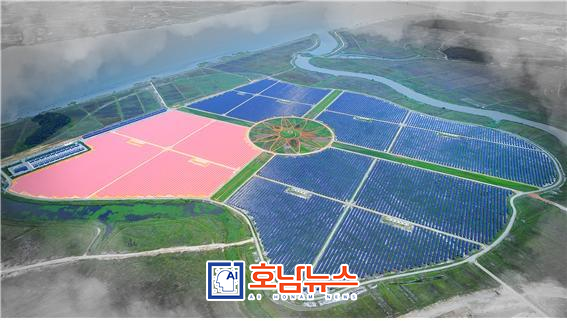 해남 솔라시도 태양광 발전소 / 사진제공=호남뉴스 |
그러나 가능성이 곧 성공을 의미하지는 않는다.
여전히 해결해야 할 과제는 명확하다.
전력망 확충의 속도, 실제 데이터센터 유치 여부, 기업 입주의 현실화, 그리고 무엇보다 정책의 지속성이 확보되지 않는다면 이번 도전 역시 과거의 반복이 될 수 있다.
결국 솔라시도의 본질은 하나의 질문으로 수렴된다.
대한민국은 수도권 중심 구조를 넘어설 수 있는가.
전력 기반 산업 구조로 전환할 수 있는가. 그리고 지역이 국가 성장의 중심이 될 수 있는가. 이 모든 질문의 답이 이곳에서 시험대에 오른다.
솔라시도는 더 이상 지역 개발사업이 아니다.
그것은 국가의 방향을 결정하는 실험이다.
첫 번째 실패는 과거의 일이지만, 두 번째 실패는 미래를 무너뜨릴 수 있다.
이제 필요한 것은 선언이 아니다.
실행이다.
속도와 결과로 증명하지 못한다면 어떤 비전도 의미를 갖지 못한다.
솔라시도는 지금, 멈춘 시간을 다시 움직이려 하고 있다.
그리고 그 움직임이 대한민국의 균형발전과 AI 산업의 미래를 가를 분기점이 되고 있다.
■ Part 2
“AI Runs on Electricity”… Can Solaseado Reshape South Korea’s Industrial Structure?
【Jeonnam·Gwangju = AI Honam News】 aihnnews@kakao.com
Solaseado now stands at the threshold of an entirely different era.
While the J-Project of the past was approached through the logic of spatial development, today’s Solaseado is being redefined as a strategic hub capable of restructuring the industrial order itself. At the center of this transformation lies a single, decisive keyword: AI—and electricity.
The AI industry no longer competes on technology alone.
Massive amounts of power are required to sustain data centers and hyperscale computing infrastructure. Ultimately, competitiveness in the AI era depends on one critical factor: how reliably and affordably electricity can be secured. At this juncture, South Korea’s industrial landscape is facing a pivotal turning point.
The Seoul metropolitan area has already reached its limits.
Power supply is insufficient, transmission networks are saturated, and responding to RE100 requirements has become structurally difficult. Companies are no longer choosing locations based solely on geography; they are now reselecting locations based on energy conditions.
In this context, Jeonnam’s significance becomes decisive.
With 10GW of solar power and 10GW of offshore wind—totaling 20GW of renewable energy potential—this is not merely a numerical figure. It represents an absolute condition capable of attracting industry. In an era where industries move to where power exists, Solaseado holds the potential to stand at the very center of this shift.
What makes this vision particularly compelling is the convergence of power, infrastructure, and technology.
A 1.2 million square meter RE100 data center park, the establishment of a National AI Computing Center, and a large-scale renewable energy base are not isolated components; they function as an integrated system. This marks a fundamental departure from past development models. It is no longer about creating land—it is about designing an industrial ecosystem.
The investment structure has also evolved.
Plans involving renewable energy, smart cities, and industrial clusters—amounting to several trillion won—are not conceived as a single, all-or-nothing project. Instead, they are structured as phased and distributed investments. This represents a shift toward a model that accumulates progress over time, rather than collapsing under a single shock.
However, potential does not guarantee success.
Critical challenges remain unresolved.
The speed of grid expansion, the actual attraction of data centers, the realization of corporate relocation, and above all, the continuity of policy—if any of these fail, this endeavor risks becoming a repetition of the past.
In the end, Solaseado converges into a single fundamental question.
Can South Korea move beyond its capital-centric structure?
Can it transition to an energy-based industrial system?
Can regions become the new engines of national growth?
The answers to all of these questions will be tested here.
Solaseado is no longer a regional development project.
It is an experiment that will determine the direction of the nation.
The first failure belongs to the past.
But a second failure could undermine the future itself.
What is needed now is not declaration—but execution.
Without proof through speed and results, no vision holds meaning.
Solaseado is now attempting to set time in motion once again.
And that movement may become the turning point that defines both South Korea’s balanced regional development and the future of its AI industry.
 ai호남뉴스 박충배 편집/칼럼/논설 aihnnewsr@kakao.com