2026.04.10 (금) 17:36



 닫기
닫기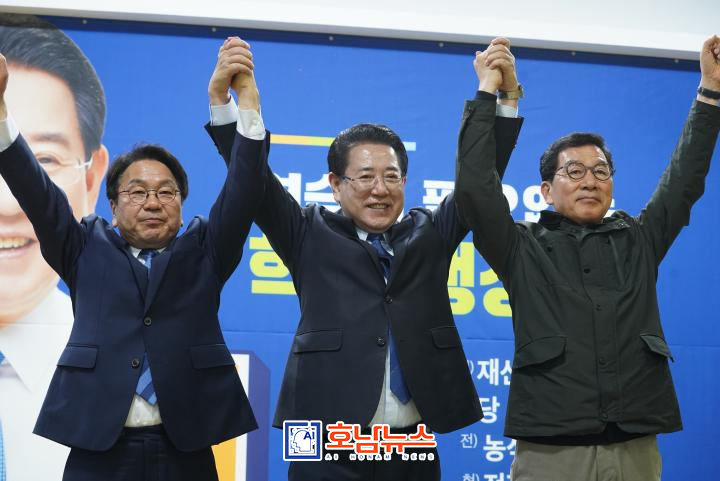 신정훈 농민정책 김영록 정책으로/ 사진제공=김영록 선대위 |
전남·광주 통합특별시장 선거가 ‘정책 통합’ 국면으로 급격히 전환되고 있다.
단순한 후보 간 연대를 넘어, 핵심 정책까지 흡수·재편되는 ‘통합형 정책 경쟁’이 본격화되는 양상이다.
김영록 더불어민주당 전남광주특별시장 예비후보는 10일, 신정훈 국회의원의 주요 농민정책을 전면 수용해 자신의 핵심 정책으로 공식화하겠다고 밝혔다.
이번 결정은 단순한 공약 차용이 아니라, 농어촌 구조 문제를 해결하기 위한 ‘정책 통합 선언’으로 해석된다.
■ “농어촌 기본소득, 인구소멸 지역부터 즉시 시행”
김 예비후보는 신정훈 의원의 대표 공약인 ‘농어촌 기본소득’을 인구소멸 고위험 지역부터 단계적으로 시행하겠다는 방침을 밝혔다.
이는 단순한 소득 보전 정책을 넘어, 농어촌 인구 유출을 막고 지역경제를 순환시키는 ‘생존형 정책’으로 작동할 전망이다.
특히 통합특별시 출범 이후 재정·행정 권한을 기반으로 한 ‘광역형 기본소득 모델’로 확장될 가능성도 제기된다.
■ “가격 폭락 막는다.”… 전남형 목표가격제 도입
농어민 생존을 위협하는 가격 변동 문제에 대해서는 보다 직접적인 해법이 제시됐다.
김 예비후보는 “농수산물 가격 폭락을 더 이상 방치하지 않겠다”며
‘전남형 농수산물 목표가격제’를 도입해 일정 가격 이하로 하락할 경우 공공이 이를 보전하는 구조를 만들겠다고 밝혔다.
이는 시장 의존 구조에서 벗어나 ‘국가·지자체 책임형 농정’으로 전환하겠다는 의미로 해석된다.
■ 교통 격차 해소… 광역요금·마을택시 동시 추진
농어촌 생활의 핵심 문제인 교통 불균형 해소 방안도 포함됐다.
김 예비후보는
▲광역버스 단일요금제 도입
▲공공형 마을택시 운영 확대를 통해 원거리 주민의 교통비 부담을 줄이고, 자가용이 없는 고령층·취약계층의 이동권을 실질적으로 보장하겠다고 밝혔다.
이는 단순 교통 정책을 넘어 ‘생활권 통합’의 핵심 기반 정책으로 평가된다.
■ “좋은 정책은 모두의 것”… 정책 연대 공식화
김 예비후보는 “적극적인 지지를 보내준 신정훈 의원의 결단에 깊이 감사드린다.”며 “전남·광주 통합특별시의 성공을 위해 서로 협력하고, 좋은 정책은 진영을 넘어서 적극 수용해 반드시 실현하겠다”고 강조했다.
정치권에서는 이번 조치를 두고 “사람의 연대를 넘어 정책까지 통합되는 새로운 정치 모델”이라는 평가가 나오고 있다.
■ 신정훈·강기정 연대 선언… 판세 재편 가속
앞서 지난 9일, 신정훈 국회의원과 강기정 광주광역시장은 김영록 예비후보 캠프에서 공식 지지와 연대를 선언한 바 있다.
이에 따라 전남·광주 통합특별시장 선거는 단순 경쟁 구도를 넘어 ‘정책 통합 vs 정책 경쟁’이라는 새로운 국면으로 빠르게 재편되고 있다.
정치권 관계자는 “이제 선거의 핵심은 인물보다 정책 실행력으로 이동하고 있다”며 “누가 더 현실적인 대안과 통합 비전을 제시하느냐가 승부를 가를 것”이라고 분석했다.
이번 정책 수용은 단순한 공약 추가가 아니다.
분산된 정책을 하나로 묶어 ‘통합특별시 체제’를 미리 구현하는 실험이 시작된 것이다.
그리고 그 실험의 결과가, 곧 전남·광주의 미래가 될 가능성이 높아지고 있다.
【Jeonnam·Gwangju = AI Honam News】 aihnnews@kakao.com
“The Board Has Been Unified”… Kim Young-rok Fully Adopts Shin Jung-hoon’s Farmers’ Policies
Subtitle: Rural Basic Income, Target Price System, Public Village Taxi… “Good Policies Belong to Everyone—Realized in the Integrated Special City”
The Jeonnam–Gwangju Integrated Special City election is rapidly shifting into a phase of policy integration.
Beyond simple alliances between candidates, a new form of “integrated policy competition”—where core agendas are absorbed and restructured—is taking shape.
Kim Young-rok, a preliminary candidate of the Democratic Party for the Jeonnam–Gwangju Integrated Special Mayor, announced on the 10th that he will fully adopt key agricultural policies proposed by National Assembly member Shin Jung-hoon and formalize them as his own core agenda.
This move is being interpreted not merely as borrowing campaign pledges, but as a declaration of policy integration aimed at addressing structural challenges in rural communities.
■ “Rural Basic Income to Be Implemented Immediately in High-Risk Areas”
Kim stated that Shin’s signature pledge, the “Rural Basic Income,” will be introduced step-by-step, starting with regions at high risk of population extinction.
This policy is expected to function not just as income support, but as a “survival policy” designed to curb rural depopulation and stimulate local economic circulation.
There is also growing anticipation that, following the launch of the Integrated Special City, it could expand into a metropolitan-scale basic income model backed by enhanced fiscal and administrative authority.
■ “We Will Stop Price Crashes”… Introducing a Jeonnam-Type Target Price System
To address volatile agricultural and fishery product prices, a more direct solution has been proposed.
Kim emphasized, “We will no longer allow price collapses to threaten farmers’ livelihoods,”
announcing the introduction of a “Jeonnam-type Target Price System,” in which public funds will compensate producers when prices fall below a certain threshold.
This signals a shift away from a purely market-dependent structure toward a state- and local government-responsibility model of agriculture.
■ Bridging the Transportation Gap… Flat-Rate Buses and Public Village Taxis
Measures to resolve transportation inequality—one of the most pressing issues in rural life—were also included.
Kim proposed:
▲ A unified fare system for intercity buses
▲ Expansion of publicly operated village taxis
These initiatives aim to reduce transportation costs for residents in remote areas and ensure practical mobility for the elderly and vulnerable populations without private vehicles.
They are seen as foundational policies for integrating daily living spheres, beyond mere transportation reform.
■ “Good Policies Belong to Everyone”… Formalizing Policy Alliance
Kim expressed gratitude, stating, “I sincerely thank Rep. Shin Jung-hoon for his strong support and decisive leadership,”
adding, “For the success of the Jeonnam–Gwangju Integrated Special City, we will work together, transcend political lines, and actively adopt and implement good policies.”
Political analysts view this move as
“a new model of politics where not only people but also policies are integrated.”
■ Shin Jung-hoon and Kang Ki-jung Declare Alliance… Accelerating Political Realignment
Previously, on the 9th, National Assembly member Shin Jung-hoon and Gwangju Mayor Kang Ki-jung officially declared their support and alliance with Kim’s campaign.
As a result, the Jeonnam–Gwangju election is rapidly evolving beyond simple competition into a new phase of
“policy integration vs. policy competition.”
A political insider commented, “The focus of the election is shifting from personalities to policy execution,”
adding, “The outcome will depend on who can present more realistic solutions and a coherent vision for integration.”
This policy adoption is not merely an addition of pledges.
It marks the beginning of an experiment to unify fragmented policies into a preemptive model of an Integrated Special City system.
And the outcome of this experiment may well shape the future of Jeonnam and Gwangju.
 ai호남뉴스 박충배 편집/칼럼/논설 aihnnewsr@kakao.com